|
DOCUMENTARY NOUR AL-MAGHREB
ISLAND OF MEMORIES
CLOUD MAN
THE CARAVAGGESCHI IL
VENTO FRA LE MURA (ITALIAN SILENT CINEMA) OUTSIDE
TRACKS MERCY
FOR GOETHE TALK
TO ME ABOUT HANNA BETWEEN
ROTHKO AND THREE WINDOWS |
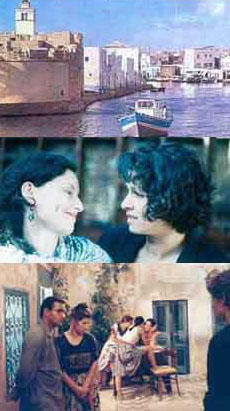
NOUR AL MAGHREB (WESTERN LIGHT) Production: Felix Film Co-production: Cinetéléfilms (Tunisia-France) International distribution: Rai Trade Screenplay and direction: Stefano Grossi Format: Digital Betacam Lenght: 52' Developed with the support of the MEDIA Programme of the European Community East - West: the journey of an European director who wonder about the difficult but necessary relationship with Arabic world, between the Western world in full bewilderment and the Eastern world with rarefied certainties. The protagonists of this documentary will be Nouri Bouzid,
the author of Les sabots d’or supposed to be the most beautiful
and important among the Tunisian films of last twenty years, and his colleagues
- Taieb Louichi, Ferid Boughedir – and the producer Ahmed Attia. Thought
their eyes as narrators and directors and with the help of their movies, we
would compose a sort of unexpected and original portrait of Arabic-Tunisian
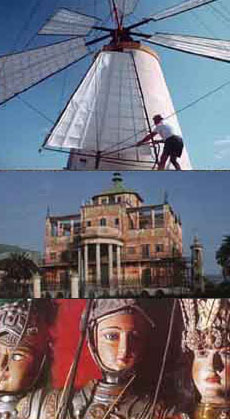
world and of his relationship with Europe and Western world. ISLAND OF MEMORIES (DOCTOR PITRE’) Production: Felix Film Co-production: Istituto Luce Fondo per lo Sviluppo Screenplay: Alessandro D’Alessandro and Marco Leopardi Direction: Alessandro D’Alessandro and Marco Leopardi Format: Digital Betacam Lenght 52' Developed with the support of the MEDIA Programme of the European Community The adventure of a young documentarist in Sicily who
is unexpectly charmed by discovering memories that he believe to belong to a
past time (feast, religious rituals, songs, crafts, etc) but he surprises to
be still existing, of a great emotional impact, as the human element is protagonist,
both solitary and choral.
Adam, a Canadian documentarist of Sicilian origins, is in Palermo
for his first time ever to do some scouting for a work about Inquisition. As
he is told that some graffiti made by prisoners in an old palace had been found
out by Giuseppe Pitrè in 1906, he decides to visit a museum that bears
Pitrè’s name. Here he is fascinated and interested by the great
deal of writings and finds Pitré had left and above all by the correspondence
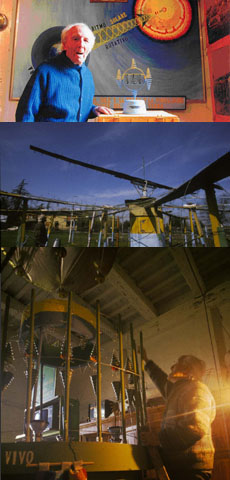
he had with so many people of his period. CLOUD MAN Production: Felix Film Co-production: Kamera film International distribution: Rai Trade Subject: Stefano Mordini and Mauro Bartoli Direction: Stefano Mordini Format: Digital Betacam Lenght: 52' If someone makes a discovery that would change the world,
the world would let to be changed?
Pier Luigi Ighina has developed theories that the authoritative science repute bizarre and raving. Yet, when his machinery go into operation something inexplicable happen… The scientist Guglielmo Marconi, soon before his death, developed
revolutionary theories kept strictly confidential; the sole traces of them can
be found in some statements made by Benito Mussolini. However, there is a man
who was a concealed assistant of the scientist, a co-worker with fertile ideas
and creative experiments, who is the one and only witness of the mysterious
Marconi’s work. This man is Pier Luigi Ighina. Pier Luigi Ighina has lived
at Imola since 1936, in a big house-laboratory near the racing track, surrounded
by imposing and colourful apparatuses capable of extraordinary things - some
can even control the atmospheric conditions. He has always said that he was
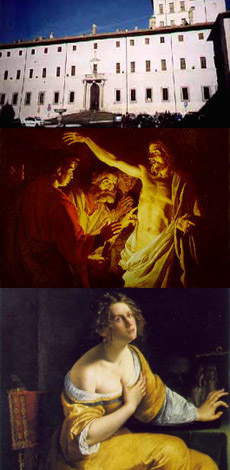
responsible for the rain that often caused problems to the Formula One races. THE CARAVAGGESCHI Production: Felix Film International distribution: Rai Trade Subject : Laura and Silvia Pettini, Mario Balsamo Screenplay and direction: Mario Balsamo Format: Digital Betacam Lenght: 52' The story of most important Caravaggeschi’s paintings,
gathered in Koelliker’s collection in Milano, one of the world most important.
From here the great exhibition at Palazzo Chigi in Ariccia, forecast to be held
in autumn 2006, will draw its contents.
It isn’t a course on an exposition event: the exhibition won’t
be shoot. IL VENTO FRA LE MURA (Italian silent cinema) Production: Felix Film With the collaboration of: Museo Nazionale del Cinema di Torino Direction: Paolo D’Amato Format: Digital Betacam Lenght: 26' / 52' Italian silent cinema started one hundred years ago in Turin.
But why in Turin? What conditions enabled the city of the House of Savoy to
maintain its supremacy, for many years, over Rome and Milan, also involved in
the revolution of cinema? Our project will try to narrate the rise and fall
of the seventh art in the capital of the region of Piedmont during a period
of great cultural ferment. The pioneers Ambrosio and Pastrone will be portrayed
as they actually were: craftsmen with a lively imagination, a bit artists, a
bit hucksters, talented impresarios, yet incapable of facing the last battle
during the crisis of cinema in the twenties. Their respective adventures, Pastrone’s
and Ambrosio’s, will be narrated by the voice of one of their fierce competitors,
whom at the time we would have defined an outsider: Ernesto Maria Pasquali..
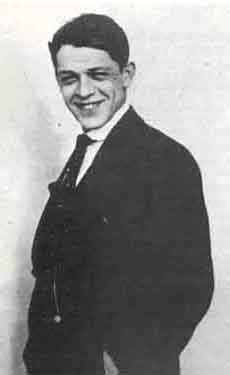
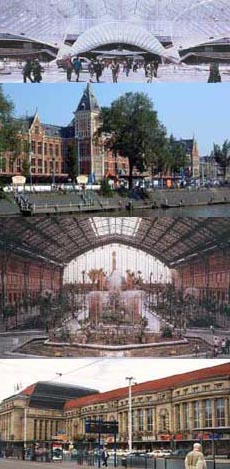
Pasquali (1883-1919) was a man of letters, before becoming a man of cinema. His original and careful analysis of the Turin society at the beginning of the 20th century emerged clearly in his fresh, spontaneous, ironic and never banal newspaper articles. He cast his inquisitive eye on people, places and events in Turin, always attentive and involved, and his pieces were a pleasure to read and had a taste that distinguished them from others due to the youthful and direct style that had nothing to do with pomposity and rhetoric. And reading them again today allows us to go back in time, to an age that was about to be violently wiped away by World War I and the changes that it would bring about. OUTSIDE TRACKS Production: Felix Film Direction: to be announced Format: Digital Betacam Lenght: 52' A full-fledged urban centre, which in its metamorphosis from a traditional model has become a place where people can meet and have social, economic and productive intercourse, narrated visiting railway stations of several European capital cities. Since the time of its invention, when trains and stations were the symbol
of “new” frenzy of the beginning of the century, from “Arrival
of a train to the station” by Lumiéres that marked the birth
of the moving art, to “trains” represented in restless futurist
painting, today the station symbolizes the recovering of a more natural rhythm,
quite slow if compared to the speed of modern communications. MERCY FOR GOETHE Production: Felix Film International distribution: Rai Trade Subject : Giorgio Pettini, Mario Balsamo Screenplay and direction: Mario Balsamo Format: Digital Betacam Lenght: 52' 8th September, 1944. Nighttime. San Tomé, a hamlet
seven kilometers from Forlì. An officer in the occupying German army
is critically wounded in a mine explosion. The attackers are not identified
but the method used would seem to rule out the partisans.
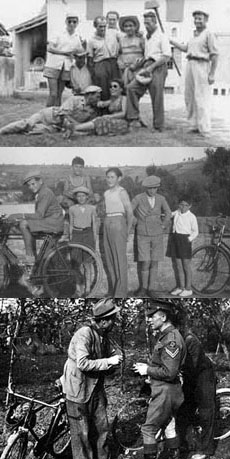
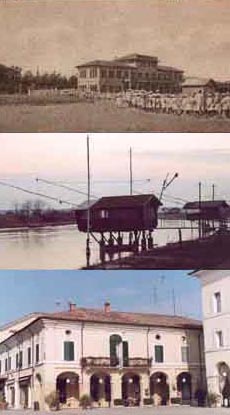
At dawn on 9th September the reprisal starts. Together, the fascist Black Brigades and a Nazi special forces unit round up two hundred and twenty peasants in the area: six of them will be hanged. At the very last minute political prisoners are substituted for the victims, but the fascists and the Nazis are merciless: they force the peasants to carry out the hangings. One of them rebels and without further ado he is added to the list of those to be executed. In all the confusion a German major stands out; he is in charge of a telecommunications unit stationed in San Tomé. Realizing how atrocious his colleagues’ decision is and relying on his rank, he opposes the Nazi special forces and has the imprisoned peasants freed, thus saving the seventh intended victim’s life and stopping innocent people from becoming executioners. The fascists and the Nazis have to bloody their own hands. The German major succeeds but his senior officers, as soon as they hear of this, punish him by sending him straight to the Russian front. Before his departure he leaves a sign of his love for Italy: a favorite book he carries everywhere with him: “Voyage to Italy” by Goethe. The massacre in San Tomé goes down in history as one of the saddest events in the history of our country, but few people remember the major who averted an even worse tragedy. TALK TO ME ABOUT HANNA Production: Felix Film Screenplay: Giorgio Pettini and Maury Dattilo Direction: Maury Dattilo Format: Digital Betacam Lenght 120' Developed with the support of the MEDIA Programme of the European Community The story is set in Cervia – Milano Marittima in the
summer of 1942. In 1942, the Riviera of Romagna, from Milano Marittima to Cesenatico,
had become a convalescent area for the ill and the wounded coming from the fronts,
where hotels were used as military hospitals. In times of peace, those buildings
were used for the summer vacations. The tourist season seemed more of an act
of faith than a commercial reality.There were very few vacationers, mainly women
- mothers with young children - because most of the men were dressed in grey-green.
Few hotels were open. The guests were mainly medical officers working at the
military hospitals who lived side by side with the rare tourists.The distant
echoes of the war were amplified by the radio news, listened to with the resignation
of those who now believed that the war for Italy was turning for the worse.
Even occasional events, such as the surfacing of a mine, were clear and dramatic
signs of the Apocalypse that was drawing nearer and nearer.
The presence of so many servicemen increased the number of spies of the Regime. The morale of servicemen had to be kept high. Religious village feasts and festivals were tolerated by the regime. Against this background, Paolo, a 19 year-old student arrives in Milano Marittima, coming from Forlì. He has just passed his school-leaving exam and enrolled at the faculty of Architecture in Florence. He has reached his father for a short holiday, who has been recently recalled to military service and detailed in Milano Marittima as administrative commander of the hospital set up on the former premises of the Montecatini company. In the hotel, Paolo recognises a very pretty and much courted school friend. He discovers and is troubled by the extreme womanliness of the maid. He feels friendship towards and has a liking for the daughter of a fisherman who has just graduated from the teachers’ training college. However, his sensitiveness and fantasy are attracted by a very young and reserved fair-haired German girl, Hanna, who is staying at the hotel with her mother and a male student friend. In the changing attitudes of the young German girl, who alternates moments of silence and sudden bursts of joy, Paolo senses there is a mystery, which initially seems to have no solution. Than unexpected love arrives and an hope for the future. Some hours before the end of 15th August feast. The day after War knocks to the door without any chance for Paolo and Hanna. This is a story that actually occurred, a metaphor of the sacrifice of generations of youths in the maelstrom of war that annihilates everything, first and foremost the pureness of love. OMICIDIO ALL'ART GALLERY Production: Felix Film Executive production: Laura and Silvia Pettini Screenplay: Corrado Paina Format: 35mm Lenght: 120’ UNDER CONSTRUCTION... |
         |